
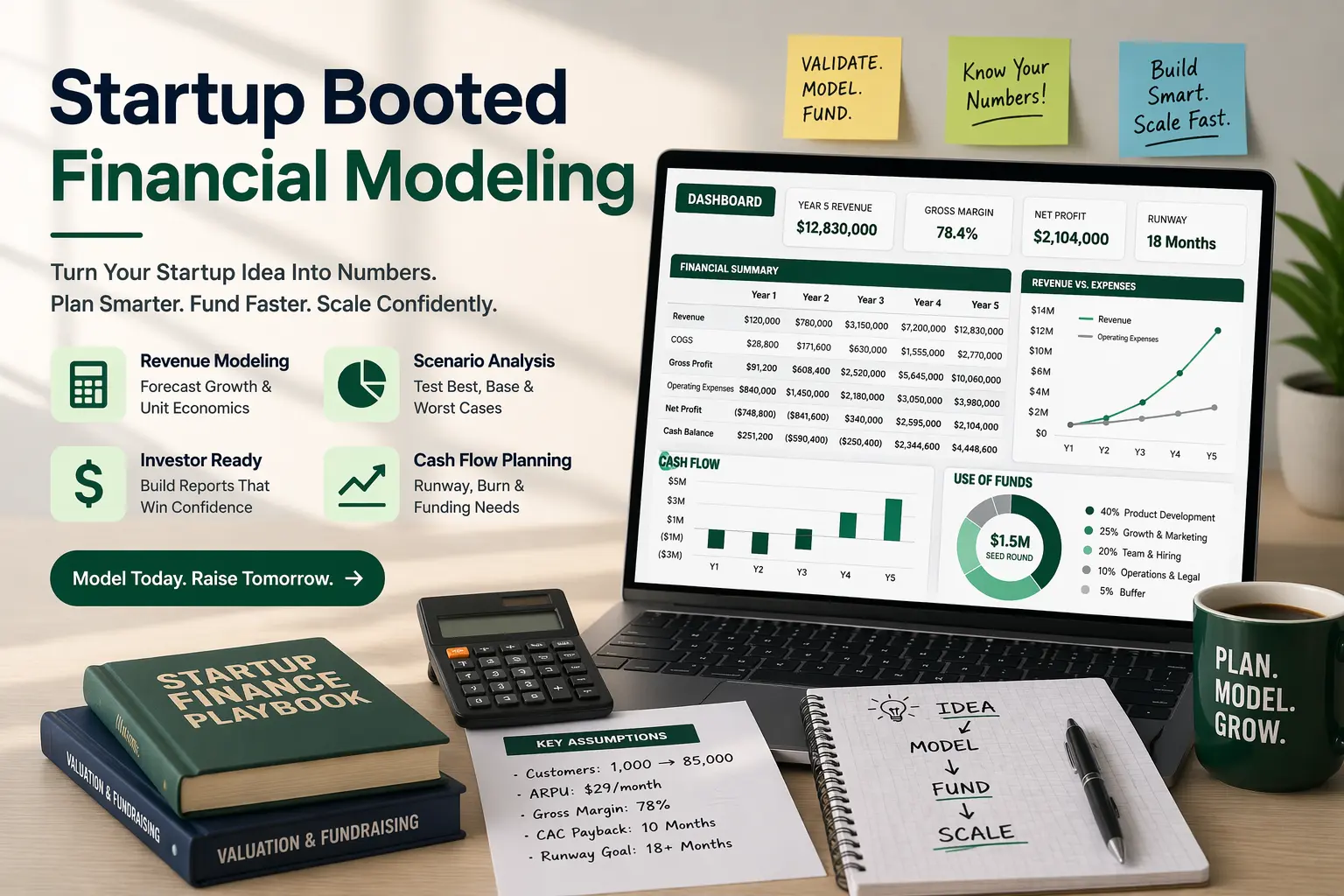
In 2005, Y Combinator began encouraging founders to build their own financial models without external funding or expensive software. This approach, known as startup booted financial modeling, relies on free tools like Excel, Google Sheets, or open-source platforms to project revenue, costs, and cash flow. It helps early-stage startups validate assumptions and manage runway without investor pressure.
How Bootstrapped Financial Models Are Built Without External Funding
Founders typically start with a simple income statement, balance sheet, and cash flow statement. They use top-down or bottom-up forecasting methods. Top-down starts with total addressable market and estimates market share. Bottom-up builds from unit economics, such as customer acquisition cost and lifetime value. Key metrics include burn rate, runway, and unit economics. Tools like Causal and Tiller have emerged for lightweight, collaborative modeling, but many still prefer spreadsheets for their flexibility and zero cost. Public records covering this story are gathered in Startup Booted Financial — Financial Modeling & Fundraising for Founders
Common Misconceptions About Bootstrapped Financial Models
One misconception is that bootstrapped models are less accurate than those built with expensive software. In reality, accuracy depends on the quality of assumptions, not the tool. Another myth is that only pre-revenue startups use them. Many successful companies, like Mailchimp, used bootstrapped models initially. However, errors in bootstrapped models can lead to mispricing or cash shortages. Paul Graham, co-founder of Y Combinator, emphasized simple, founder-built models over complex spreadsheets to avoid over-engineering.
Timeline of Key Moments in Bootstrapped Financial Modeling
Y Combinator popularized the approach starting in 2005. In 2010, the lean startup movement further emphasized bootstrapped financial modeling as a way to test hypotheses quickly. By 2020, the rise of no-code tools made it easier for non-finance founders to build models. The venture capital slowdown in 2023-2024 led to increased adoption, as founders sought to extend runway without external funding. Today, bootstrapped financial modeling is a standard practice in many accelerator programs.
| Year | Milestone |
|---|---|
| 2005 | Y Combinator promotes founder-built models |
| 2010 | Lean startup movement adopts bootstrapped modeling |
| 2020 | No-code tools like Causal emerge |
| 2023-2024 | Increased use due to VC slowdown |
Current Status and What Comes Next for Bootstrapped Financial Modeling
As of 2024, bootstrapped financial modeling remains a core skill for lean startups. The trend toward remote work and distributed teams has increased reliance on cloud-based spreadsheets. New tools like Tiller offer automated data feeds from bank accounts, reducing manual entry. However, the fundamental principles remain unchanged: focus on key drivers, keep it simple, and update assumptions regularly. The approach is likely to persist as long as venture capital remains selective and founders seek capital-efficient growth.
Frequently Asked Questions
Where can I find templates for startup booted financial modeling?
Many free templates are available online from sources like Y Combinator’s Startup School, SCORE, and various startup blogs. These templates typically include income statements, cash flow projections, and key metric trackers. You can also find community-shared spreadsheets on platforms like Reddit’s r/startups.
What is startup booted financial modeling best known for?
It is best known for enabling founders to build financial projections without external funding or expensive software. This approach emphasizes simplicity, founder ownership, and rapid iteration. It has been widely adopted in accelerator programs and lean startup methodologies.
When did bootstrapped financial modeling become popular?
It gained popularity around 2005 when Y Combinator started encouraging founders to build their own models. The lean startup movement in 2010 further boosted its adoption. The VC slowdown in 2023-2024 led to a resurgence as founders sought to extend runway.
Why did bootstrapped financial modeling become more common in 2023-2024?
The venture capital slowdown made external funding harder to secure. Founders needed to manage cash carefully and extend runway. Bootstrapped financial modeling allowed them to project cash flow and make informed decisions without investor pressure. It also helped validate business models before seeking funding.
Who is Paul Graham and what is his role in bootstrapped financial modeling?
Paul Graham is a co-founder of Y Combinator. He advocated for simple, founder-built financial models over complex spreadsheets. His essays and talks emphasized that founders should understand their numbers deeply. This philosophy influenced many startups to adopt bootstrapped financial modeling.
Practical Tips for Building Your First Bootstrapped Financial Model
Start with a single sheet that tracks your three most important metrics: revenue, expenses, and cash balance. Avoid adding too many variables initially. Focus on the assumptions that truly drive your business, such as customer acquisition cost and monthly recurring revenue. Update the model weekly, not daily, to avoid over-optimization. Share it with co-founders and advisors for feedback.
How Bootstrapped Financial Modeling Differs from Traditional Approaches
Traditional financial modeling often involves dedicated finance teams and expensive software like Adaptive Insights or Anaplan. Bootstrapped models, by contrast, are built by founders themselves using free tools. They prioritize speed and flexibility over granular detail. While traditional models may include dozens of linked sheets, bootstrapped models typically have fewer than ten tabs. This simplicity makes them easier to update and understand, which is critical for early-stage decision-making.








Leave a Reply